TannerRitchie has today published 6 new volumes from the Camden Society, incorporating an even more than usually colourful collection of letters, diaries, papers and accounts.
Today's publications include:
The Private Diary of Dr John Dee: Renaissance mathematician, astronomer, astrologer, occultist, navigator, imperialist, and subject of Damon Albarn's opera which premiered on July 1st, 2011. A true renaissance man, Dee's seriousness as a mathemetician should not be overshadowed (well, maybe just a bit) by the fact that he spent the last thirty years of his life trying to commune with angels.
Plumpton Correspondence. A series of letters written in the reigns of Edward IV, Richard III, Henry VII & Henry VIII: An edition of the correspondence of a medieval aristocratic family from Northumberland - one of the few collections of letters from that period, covering everything from high politics and war with Scotland, to the weather.
Letters of the Earl of Perth to his Sister: A collection of letters between the earl and his sister that begins with a gripping and detailed account of the earl and his wife's attempt to flee Scotland in disguise, and through deep snow, after the deposition of James VII and II (the last Stuart king) in 1688. The earl's ship was caught in the Firth of Forth, and he was imprisoned until 1693. The letters continue until after the earl was eventually freed on condition that he went into exile, whereupon he joined the Jacobite court at St Germain. The sympathy towards the earl's predicament is somewhat mitigated by the fact that he introduced the thumbscrew to Scotland.
Egerton Papers: Letters from the reigns of Henry VII to James I.
Accounts and Papers Relating to Mary Queen of Scots: Primarily containing the accounts of the expense incurred by the queen's imprisonment in England, the expenses on her funeral, and Queen Elizabeth's 'Justification' for her treatment of Queen Mary.
Letters of Eminent Literary Men (1542-1799): A typical collection of colourful letters, but this time all written by men with some connection to literature or the arts. Two such letters were written by John Stubbs, a pampleteer and political commentator, sent from the Tower of London, where he was imprisoned by Queen Elizabeth for sedition. The letters were written with his left hand, because he had been sentenced to have his right hand cut off with a butcher's knife and mallet. According to Wikipedia: 'Immediately before the public dismemberment, Stubbs delivered a shocking pun: "Pray for me now, my calamity is at hand." His right hand having been cut off, he removed his hat with his left, and cried "God Save the Queen!" before fainting.'
Thursday, July 7, 2011


Thursday, May 26, 2011
The Bairns' Ploy: How children helped Mary Queen of Scots' escape from Loch Leven Castle
I came across this entry detailing the escape of Mary Queen of Scots from Loch Leven Castle in May 1568. Maybe I was a bad historian, but I never knew how it was actually achieved! Nothing like the Venetians for providing a lot of detail ... best calendar series for gossip and unabridged detail!
 |
| A romantic and anachronistic depiction of Mary's escape by Sheriff |
The account is noteable, among other things, for the reliance on the bravery and discretion of a numbe rof young boys and girls, mostly under the age of ten, who were employed as pages and maids at the castle, to sneak the queen out of the gate, and then lock her erstwhile captors in while they fled by boat across the loch.
The Escape of Mary Queen of Scots from Loch Leven Castle as written by Giovanni Correr, Venetian Ambassador in France, 26 May 1568 (CSP Venice, volume 7 (1558-1580), no. 425, pp. 414-417).
A gentleman came from Scotland with confirmation of the Queen’s flight, which took place thus.
The Queen of Scotland was advised by Lord Seton, her most confidential Catholic friend, and a very brave gentleman, by means of a lad in the house who never returned, that he on an appointed day would be with about fifty horsemen at the lake of Lochleven, where the Queen was held prisoner. Seton remained with forty horsemen in the mountains at a short distance, so as not to be discovered by the occupants of the castle in the lake, and the other ten, approaching nearer, entered a village, pretending to be travellers; and one of these men went to the edge of the lake itself, and prostrating himself on the ground, so as not to be seen waited, according to the order given, until the Queen should come forth, as arranged.
Guard was continually kept at the castle gate day and night, except during supper, and the key was always placed on the table where the Governor took his meals, and before him. The Governor is the uterine brother of the Earl of Murray, Regent of Scotland, the Queen’s illegitimate brother and her mortal enemy. The Queen, having attempted to descend from a window unsuccessfully, contrived that a page of the Governor’s, whom she had persuaded to this effect, when carrying a dish, in the evening of the 2nd of May, to the table of his master with a napkin before him, should place the napkin on the key, and in removing the napkin take up the key with it, and carry it away unperceived by anyone.
Having done so, the page then went directly to the Queen, and told her all was ready; and she, having in the meanwhile been attired by the elder of the two maids who waited upon her, took with her by the hand the younger maid, a girl ten years old, and with the page went quietly to the door, and he having opened it, the Queen went out with him and the younger girl, and locked the gate outside with the same key, without which it could not be opened from within.
They then got into a little boat which was kept for the service of the castle, and displaying a white veil of the Queen’s with a red tassel, she made the concerted signal to those who awaited her, that she was approaching. On seeing this, the person stretched on the ground on the bank of the lake arose, and by another signal summoned the horseman from the village, amongst whom a principal person was he [John Beaton] who is now come to give account of these facts to these Majesties [in France], and who is the brother of the Scottish Ambassador here [James Beaton, Bishop of Glasgow]. The horsemen from the mountains being also informed came immediately to the lake, and received the Queen with infinite joy, and having placed her on horseback with the page and the girl, they conveyed her to the sea coast, at a distance of five miles from thence, because to proceed by land to the place which had been designated appeared manifestly too dangerous.
 |
| Looking across to Loch Leven Castle, with the Ochil Hills behind |
... With regard to her flight, it is judged here, by those who know the site, and how strictly she was guarded, that her escape was most miraculous, most especially having been contrived by two lads, under ten years of age, who could not be presupposed to have the requisite judgment and secrecy. To the greater satisfaction with the result may be added, that the inmates of Lochleven Castle perceived the flight; but being shut up within it, and thus made prisoners, they had to take patience, and to witness the Queen’s escape, while they remained at the windows of the castle.
All having embarked, the Queen was conducted to Niddry, a place belonging to Lord Seton, and from thence to Hamilton, a castle of the Duke of Chatelherault , where his brother, the Archbishop of St Andrews, with other principal personages of those parts, acknowledged her as Queen.
... All Scotland is in motion, some declaring for the Queen, and some against her for the Earl of Murray.
And so the Marian Civil Wars officially began.
[Public domain images from Wikipedia.]
Monday, May 16, 2011
The best books and the best research tools - now from $10
If you are interested in the medieval or early modern past, the most important research tool for your research is now easier and cheaper than ever to access.
Not only are we currently providing personal access to Medieval and Early Modern Sources Online (MEMSO) at our cheapest rates during the Spring Sale, but you can now also access MEMSO for just $10, with unlimited searches, the ability to view and print the books contained in MEMSO, and the ability to download from our large collection of images from the British State Papers.
Why do I need access to MEMSO?
MEMSO contains a constantly growing collection of key sources for medieval and early modern history, specializing in the history of Britain and it relations with Europe, Colonial North America and Asia. MEMSO is also widely used across the humanities, and a key resource for English literature, religion and legal history.
But MEMSO is much than a simple collection of sources. MEMSO provides advanced tools to exploit the sources in ways impossible with the original books, or through any other web interface:-
TannerRitchie Publishing: The Trusted Source for Trusted Sources.
Free trials for institutions also available: contact us for details.
*Not included in $10 access period.
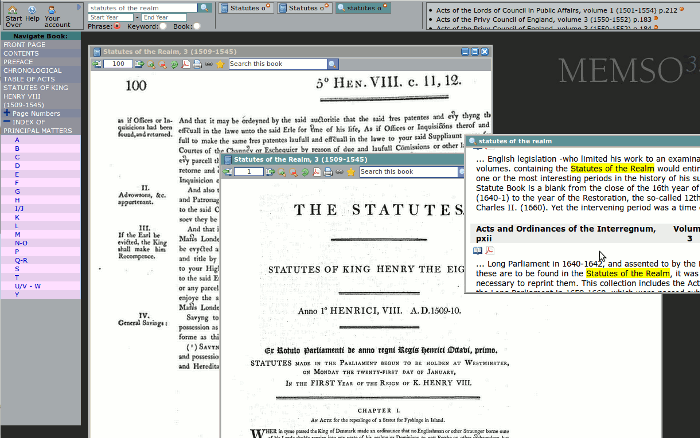 |
| Working with multiple sources. |
Why do I need access to MEMSO?
MEMSO contains a constantly growing collection of key sources for medieval and early modern history, specializing in the history of Britain and it relations with Europe, Colonial North America and Asia. MEMSO is also widely used across the humanities, and a key resource for English literature, religion and legal history.
But MEMSO is much than a simple collection of sources. MEMSO provides advanced tools to exploit the sources in ways impossible with the original books, or through any other web interface:-
- Advanced, instantaneous full text searches of the entire resource, or just the sub-sets of sources you use.
- Detailed bookmark navigation for each and every source in the database to find the material you need quickly - a unique and important difference between MEMSO and other online publications.
- Consult multiple books and manuscripts, side by side. Researchers rarely have one book open at a time - you need to be able to open and compare many books at once. MEMSO implements an advanced desktop/window interface that lets you consult the sources in a way that dramatically increases the power and accessibility of this research tool.
- Download full ebooks* and high definition scans of manuscripts to keep forever, print in full or use offline.
It's not just the books - it's how you can use them.
Designed by historians for historians, MEMSO is the unquestioned leader in providing, quality, accessible, historical sources, optimized for the way YOU work.
TannerRitchie Publishing: The Trusted Source for Trusted Sources.
Free trials for institutions also available: contact us for details.
*Not included in $10 access period.
 |
| The many different ways to use and view sources in MEMSO on display. |
Thursday, May 5, 2011
SPRING SALE! Save on Short-Term Personal Access to MEMSO
|
| Screenshot of MEMSO in action |
Experience the power of MEMSO for yourself:
- Our virtual desktop and windowing system lets you conduct multiple searches and work with as many books as you like simultaneously
- Access our entire collection and keep ebooks permanently at the end of your access period.
It’s not just about the books, but how you can use them.
Buy access now!
| Access period | Reg. | % Off | Price | Ebooks to keep† |
|---|---|---|---|---|
| 1 day | $45.00 | 10% | $40.50 CAD | 4 complete ebooks. |
| 3 days | $90.00 | 10% | $81.00 CAD | 10 complete ebooks. |
| 1 week | $135.00 | 15% | $114.75 CAD | 20 complete ebooks. |
| 30 days | $225.00 | 15% | $191.25 CAD | 25 complete ebooks. |
| 90 days | $360.00 | 20% | $288.00 CAD | 50 complete ebooks. |
†Ebooks to download and keep after the end of your access period.
Thursday, March 24, 2011
Fasti Ecclesiae Scoticanae published
This week we have begun the process of republishing Hew Scott's monumental Fasti Ecclesiae Scoticanae, one of the most valuable reference works for historians of early modern and modern Scotland. Despite appearances, Fasti is not in Latin, and contains biographies of the Scottish presbyterian clergy between the Reformation in 1560 and 1900.
As always, TannerRitchie Publishing's editions don't just contain a simple digital scan of the work, but add a detailed navigation and search system that enormously increases the value of the works for researchers. Using the bookmarks, you can quickly get where you want in the books, which the full text search adds another dimension unavailable in the original volumes. Priced at $20, the volumes in Fasti are incredible value for valuable research tools.
Meanwhile, as part of MEMSO, Fasti can be used side-by-side with the primary sources, or saved to your personal bookshelf for for frequent reference.
Check out the first volumes of Fasti, available now, and keep on checking back as we complete the series in the weeks ahead.
 |
| "Your faithful & obedient servant, Hew Scott", editor of Fasti |
Meanwhile, as part of MEMSO, Fasti can be used side-by-side with the primary sources, or saved to your personal bookshelf for for frequent reference.
Check out the first volumes of Fasti, available now, and keep on checking back as we complete the series in the weeks ahead.
Friday, February 18, 2011
New titles: 18 February 2011
This week's crop of new titles include charters from the Register of Brechin Cathedral - a collection of rare documents and charters from medieval Scotland until the Reformation - and the continuation of our publication of the Historical Manuscripts Commission Manuscripts of the House of Lords Series.
- Calendar of the Manuscripts of the Marquis of Bath, vol. 1 (1643-1795)
- Calendar of State Papers, Venice and Northern Italy, vol. 35 (1666-1668)
- Registrum Episcopatus Brechinensis, vol. 2 (1222-1674)
- Registrum Episcopatus Brechinensis, vol. 1 (1165-1553)
- Manuscripts of the House of Lords, New Series, vol. 8 (1708-1710)
- Manuscripts of the House of Lords, New Series, vol. 7 (1706-1708)
Monday, February 14, 2011
The Valentine who stole more than a heart - Early Modern Valentine's Day celebrations in England and Scotland
Many of us think that, today, holidays have become too commercialized; the focus being on the material rather than the true meaning of the day. Valentine’s Day, it would seem, is no exception. No sooner is Christmas over than the aisles of shops become awash with pink and red plastic crap.
Over the past couple of years, we’ve been using MEMSO (www.tannerritchie.com/memso.php) to find interesting tweets for Twitter (where, incidentally, you can follow us @tannerritchie). Needless to say, given the extent of our catalogue, we’ve come up with some real gems – quite literally in the case for references to Valentine’s Day.
There are over 2600 hits to the word ‘Valentine’ in MEMSO. Most references, however, are Christian or surnames (Valentine Minge and Valentine Boyles are the ones that stick in one’s mind), names of ships, or references to the feast day itself, used to date letters, events, or payment terms etc. But hidden in and amongst these are some other references about how Valentine’s Day was celebrated in the Early Modern Period. And they seem to have set the bar pretty high in terms of the ‘bling’!!
In 1522, at the court of Henry VIII, the Spanish Ambassador reports the following to Charles V:
 |
| The young Mary Tudor, shown wearing her Valentine's badge, reading 'The Emperour' (public domain image) |

"After dinner, at the tournament, we were presented by the cardinal [Wolsey] to the queen [Catherine of Aragon] and the princess Mary ... Catherine asked affectionately after you majesty’s health and the prosperity of your affairs, and said that nothing in the world so rejoiced her as to hear of your health and happiness. Then, after we had saluted the princess, she continued to question me not less sweetly than prudently, about your majesty, and there was much pleasant conversation, especially about the charms of the little princess, who, it should be noticed, wore on her bosom a golden brooch ornamented with jewels forming your majesty’s name, which name she had taken on St. Valentine’s Day for her valentine, which seems a happy augury."Princess Mary was just shy of her sixth birthday at the time.
 |
| Anne Dacre, countess of Arundel, failing to look like anyone's idea of a fun Valentine. (Public domain image) |

Another tradition at Court was the act of picking the name of one’s Valentine.
In 1618, the Venetian Ambassador wrote at length about how Valentine’s Day was celebrated by the upper echelons of English society, including at Court.
‘Any woman soever, however noble, even if she be married, fails not to have her valentine, and the men also have their valentines. They revel changes annually thus. On St. Valentine’s eve they place in two ballot boxes sundry tickets whereon are inscribed the names of the men and women of the company, each of whom draws a ticket in turn. Those thus coupled by chance unite together much more closely than if their love were loyal; they banquet together and exchange presents, each preserving the ticket which for some days the man wears in his hat and the woman in her bosom. They even have their names engraved in gold, the invariable rule being that the Valentine do kiss his lady whenever he meets her. Nor may this appear strange to your lordships, for the like style prevails at the court also without excepting the king [James I], the prince [Charles] and the queen [Anne of Denmark], whose hand alone is generally kissed.’
The ambassador concludes by writing, ‘Were it lawful for me to consign to paper certain other peculiarities which are usual among the middle and lower classes, I should astound you’. Ah, come on!!!!
Finally, there were several references to the giving of Valentines in the Register of the Privy Council for Scotland ... but these, however, were decidedly less romantic than their English counterparts. In 1561, for example, heads of the prominent families on the Scottish Border were summoned and appeared before Mary Queen of Scots and her Council. There, they ‘ressavit their valentinis of the names culpable of thift and utheris crymes, and wer chargit to apprehend and tak the samyn personis contenit in the saidis valentinis...’ Later in the 1570s, valentines, as letters containing names of persons to be apprehended, continued to be used in this way.
Well, whatever rocks your boat. Cheaper than jewelry.
So, whether it is the giving of expensive pieces of jewelry or the apprehension of criminals, the people of Early Modern England and Scotland certainly are a hard act to follow. The pink and red plastic crap doesn’t look so bad now.
Suggested reading:
Register of the Privy Council, Scotland, 3 series
Calendar of State Papers, Spain
Calendar of State Papers, Venice and Northern Italy
Suggested reading:
Register of the Privy Council, Scotland, 3 series
Calendar of State Papers, Spain
Calendar of State Papers, Venice and Northern Italy
Subscribe to:
Posts (Atom)