Thursday, December 1, 2011

TannerRitchie's Holiday and New Year Sale 2011!


 All downloads are $10 or less.
CD-ROMs 50% off.
Discounts on Short-Term Access to MEMSO!

It's that time of year again for TannerRitchie's biggest and most popular sale.

Nothing says Christmas
like a collection of monastic charters
(mead sold separately)

Forget Black Friday and Cyber Monday, at TannerRitchie we give you more than a day to take advantage of the huge savings on every book in our catalogue. Downloads are $10 CAD or less, and CD-ROMs are half price.

Alternatively, take advantage of our sale on Short-Term Subscriptions to MEMSO, and access our entire collection of books and manuscripts in our powerful online database.

Research has never been so easy with MEMSO's powerful search engine.  Conduct limitless searches and work with as many books and manuscripts as you want .... at the same time. You even get ebooks to keep*  So go on.  Try MEMSO for an hour, a couple of days, or longer.


Highlights of 2011

We've added hundreds of new titles and will be adding more during the sale - so be sure to visit tannerritchie.com regularly.

During 2011 we've added books to our most popular series, and also published fantastic collections of under-appreciated and underused sources.


Scottish and Genealogy

Scottish and genealogical titles are a perennial favourite at TannerRitchie. This year we added some important new series, such as Hew Scott's Fasti Ecclesiae Scoticanae (the biographies of the ministers of the Scottish Church since the Reformation in 1560 to 1900, in English), and built on existing ones, such as William Fraser's Scottish family histories which cover the medieval period to the 19th century, and include those of Colquhoun, Grant, Elphinstone and Wemyss amongst others.

A wide variety of interesting documents and family papers were also published by the Abbotsford and Bannatyne Clubs.  So if you are interested in these, or Mary Queen of Scots, James VI and the Jacobites, be sure to take a look in our History Club Section. Many of these titles are hidden gems, such as Catalogues of Jewels, Dresses, Furniture, Books and Paintings of Mary Queen of Scots (Bannatyne). As always with TannerRitchie, there was a great deal of new and illuminating content for anybody interested in the reign of Mary Queen of Scots or the Jacobites.

Letters and Correspondence

If you're looking for colourful correspondence, few collections are better than Calendar of the Manuscripts of the Marquis of Bath (Historical Manuscripts Commission).  They are a mainstay for our tweets on Twitter, most notably because they include a high proportion of gossipy and personal correspondence for the period 1515-1795, including noteable writers of England's literary Golden Age such as Swift and Pope. The Original Letters of Prominent Literary Men from the Camden Society, provides great reading for the same reason.

Letters and papers from royals (Elizabeth, James VI and I and Charles I) and prominent political men and families also featured prominently this year. 

Savile, Plumpton, Trevelyan, Melros, Egerton, Dudley, and Verney are but a few collections we've added.


Medieval Britain and the Church

The Toronto Maple Leafs workout, circa 1500.
Shortly after they won the Stanley Cup.
The twin subjects of medieval Britain and the pre- and post-Reformation church have always been specialisms of TannerRitchie Publishing. This year we continued to build on core series such as the Exchequer Rolls, Calendar of Close Rolls and Calendar of the Patent Rolls, and published new collections from the Pipe Rolls and Rotuli Hundredorum. For the church, both Abbotsford and Bannatyne provide collections of ecclesiastical records.

Early Modern Britain

As well as many of the titles already mentioned relating to early modern Britain, we've continued to publish new titles to many of our most popular collections. Make sure you take a new look at Calendar of State Papers, Venice, Calendar of State Papers, Domestic and the Acts of the Privy Council of England, if you haven't checked out our titles for a while. We're excited to announce that we are also beginning to publish the  Journals of the House of Commons and the Journals of the House of Lords, with titles to appear over the next few weeks.  Needless to say, these will be a valuable addition to MEMSO, and a natural compliment to our already extensive collection of governmental works such as the House of Lords (HMC), Statutes of the Realm, Foedera, and Register of the Privy Council of Scotland.


There's so much more to say, but we'll leave the rest for you to explore.

So in closing, from all of us here at TannerRitchie Publishing we would like to wish all our clients, supporters and followers a very Merry Christmas, Happy Holidays and Happy New Year!
* excludes 1 hour MEMSO access


Monday, October 24, 2011

THE STUFF FAIRY TALES ARE MADE OF

James VI in 1595

On 23 October 1589, the Scottish Privy Council assembled in Edinburgh (From Register of the Privy Council of Scotland, volume 4) and heard several documents read by the Clerk Register from their king, James VI. The first was a Will for the future government of the kingdom, and the second, a Declaration explaining the reasons why such a Will was necessary. James was leaving to embark on a rather uncharacteristic and ostensibly romantic quest. Although James knew that this was not the most prudent thing to do in light of the factional politics and disorder that had undermined the strength and stability of his realm, he needed to go. He needed to rescue his bride, Anne, and bring her to her new home.


The marriage treaty between James VI and Anne, daughter of the late Frederick II of Denmark, was formally concluded in July 1589. For her part, the 15 year old Anne was quite smitten with her future husband – no doubt sheltered from the persistent rumours of James’ sexual orientation(s). The marriage took place by proxy on 29 August at Kronburg Castle, with the Earl Marischal standing in for James VI – even so far as sitting on the marriage bed to consummate the marriage symbolically. Ten days later, Anne embarked for Scotland, where dates had been set, and elaborate arrangements made, for her arrival at the port of Leith, entry into Edinburgh, and formal marriage ceremony with James himself.
Anne of Denmark in 1605

Anne’s voyage from Denmark to Scotland, however, was not clear sailing. Stormy weather and contrary
winds had separated her fleet and drove the Princess’ ship to the Norwegian coast. Although some of her fleet had arrived in Scotland, there was still no sight of Anne. With the day of the appointed marriage come and gone, James’ impatience turned to worry, and on 2 October, he sent out a search party. Colonel Stewart’s delayed return led to a further period of ‘fear of disaster; omens; public fast and prayer’. Finally, messengers arrived from Denmark, informing James that Anne’s fleet had been driven back twice, her ship the Gideon had sprung perilous leaks before and after repairs, and had finally taken refuge on the coast of Norway as it was deemed too dangerous to try again for a third time. The question was now whether Princess Anne should return to Denmark and winter there, attempting the voyage to Scotland again in the spring, or try again now. Indeed, this had become a matter of great contention between the Scots and the Danes. James, however, had other ideas.
And so it was on 23 October, the Privy Council of Scotland learnt of the news that James VI was leaving on a quest, to fetch his bride personally.
Quhairupoun, eftir lang treaty and deliberatioun, contract being endit, the marriage be our ambassador in our name solmpnizat, and the Quene, oure espoused wyffe, accumpanyed with the navy of oure darrest bruthir the King of Denmark and certane of his cheiff officiaris and counsaill appointed to convoy hir towardis us, being on the seyis halding their course hither, have bene divers tymes be stormes and contrarious wyndis sett in Norroway, - quahir deliberatioun being had anent hir returning in Denmark or tarrying still in Norroway upoun mair favourable wind and weddir and sum further provisioun towardis hir transporting, hir awne chois and lykeing best aggreing with the last conditioun, - We, to quhome hir bipast panes and dangeir hes bene no les grievous nor giff we had sufferit thame in our awne persone, finding that nothing can be mair hurtfull to us and oure estate nor giff the consummatioun of oure marriage and the transporting of the Quene oure bedfellow in oure realme salbe differed, and that hir affectioun towardis us, having sa effectuallie kytheit, meritis to be rememberit and acquite with na les goodwill on oure pairt; quhairthrow, thinking to mak the process schoirtair, and to obviate the difficulties objected concerning hir transporting befoir the nixt spring, eftir we had resolvit to send in Norroway a noumer of oure counsaill and officiaris that voluntarlie offerrit to bestow thameselffis and their geir in furtherance of this eirand, we fand yit na contentment of mynd quhill we concludit to interprise the voyage in proper persone [ie himself], thinking, be Godis grace, to performe the same and fra in [ie within] tuenty dayis, wind and wethir serving.
James was going himself, and set out in explicit detail provisions for the future government of the realm in his absence. But what is, perhaps, of greater interest is what followed next – a Declaration, written by James VI himself, explaining the personal reasons behind his decision to fetch his ‘bedfellow’ and consummate his marriage.

In respect I knaw that the motioun of my voyage at this tyme wilbe diverslie skansit upoun, the misinterpreting quhairof may ten alsweill to my grite dishonour as to the wrangous blame of innocentis, I have thairupoun bene moved to sett doun this present Declaratioun with my awne hand, heirby to resolve all gude subjectis first of the causes breiflie that moved me to tak this purpois in heid, and nixt in quhat fassioun I resolved myself thairof.
 

As to the causes, I doubt nocht it is manifestlie knawne to all how far I wes generallie found fault with be all men for the delaying sa lang of my marriage. The ressonis wer that I wes allane, without fader or moder, bruthir or suster, king of this realme and air apperand of England. This my naikatnes maid me to be waik [weak] and my inemyis stark; ane man wes as na man, and the want of hoip of successioun bread disdayne; yea, my lang delay bred in the breistis of mony a grite jealosie of my inhabilitie, and gif I wer a barrane stok.

While it is true that the primary duty of any sovereign, male or female, is to produce heirs to the throne to secure the line of succession and, consequently, the stability of the realm, James loved the life of a bachelor, the company of men and other such manly pursuits. So, to blame the fact that he took so long to marry on his family (or lack thereof) was a little disingenuous. But, it is reassuring that the pressure to marry and produce heirs wasn’t only a problem associated with queenship. Moreover, it is tempting to read into first, James’s choice of language and second, his reaction to the gossiping and contempt regarding his failure to marry, as sensitivity to rumours of his homosexuality (or as it would have been termed at the time, his preference for male company and apparent disinterest in women). He repeatedly refers to Anne as his ‘bedfellow’, a term that might be interpreted as deliberately emphasizing the heterosexual nature of the relationship. Thus, while one of James’s earliest biographers, Arthur Wilson, saw James’s journey as ‘the one romantic episode of his life’, here he seems to be objecting that he has been pushed into marriage sooner than he had hoped by malicious gossip, and can find no peace until the marriage has been consummated.


Thir ressonis, and innumerable otheris hourly objected, moved me to hasten the treaty of my marriage; for as to my awne nature, God is my witness, I could have abstenit langair nor the weill of my patrie could have permitted. I am knowne, God be prased, not to be very intermperately rashe nor concety [flighty] in my wechtiest effearis [weightiest affairs], nather use I to be sa caryed away with passioun as I refuse to heir ressoun.
In an attempt to convince his Council that he was not influenced by any one, or any particular faction to undertake such an uncharacteristic mission, James took pains to assure his counsellors that he came to this decision alone – ‘not ane of the hail Counsale being present ... And, as I tuke this resolutioun onlie of myself, as I am a trew Prince, sa advised with myself onlie quhat way to follow furth of the same.’
Hence the reason this voyage was kept so secret:
Fra the tyme of the making of this offer, have evir kepit my intentioun of my going asl clois as possiblie I could frome all men, because I thocht ay it we aneuch [enough] for me to putt my fute n the ship quehn all thingis wer redy without spearing of further [ie any further debate or enquiry]. As I kepit it generallie clois fra all men, sa I say, upoun my honour, I kepit is sa from the Chancellair.’ Because if he had informed him, he would be ‘blameit of putting it [in] my heid’.
James sailed from Leith and arrived in Oslo on 19 November, where they were married in a formal ceremony four days later. The newlyweds wintered in Norway and Denmark, before setting sail for Scotland in the spring. They arrived at Leith on 1 May 1590, and Anne made her entry into Edinburgh on 5 May – in a coach of silver brought over from Denmark. Scotland’s new Queen was crowned on 17 May at Holyrood, which was of particular significance because it was Scotland’s first ever Protestant coronation. The ceremony was also controversial, particularly with the kirk ministers. James insisted that rituals dating, he claimed, to the Old Testament be incorporated in the ceremony – namely, the opening of the Queen’s gown so that her breasts and arm could be anointed with oil.

George Villiers, duke of Buckingham, was James VI & I's final favourite. James described him as 'sweet child and wife' and a secret passageway was built between Villiers' bedroom and James' at Apethorpe Hall, which was only discovered in 2004/8. Nevertheless, there is no unambiguous evidence that James' relationships with his favourites was other than platonic.


Unfortunately, James and Anne’s marriage was not characterised by ‘smooth sailing’ any more than the first months of their marriage. Their marriage was fractious and, although they had four children, they spent most of their lives apart, especially after James inherited the throne of England. Moreover, even the ‘romantic’ journey to Norway and apparently genuine initial infatuation of James VI for Anne after her arrival in Scotland did not permanently dispel the gossip regarding James’ preference for male company, especially when it took three years for Anne to become pregnant. The eventual birth of seven live children helped quieten the rumour-mongers again, but the king’s intimate relationships with male favourites, and perhaps the 21st century need to assign people from earlier periods to categories that would have been meaningless at the time, mean that the question of James’s sexuality remains today.

Thursday, July 7, 2011

Camden Society Volumes: Colourful diaries, accounts, letters and papers from 'eminent' people

TannerRitchie has today published 6 new volumes from the Camden Society, incorporating an even more than usually colourful collection of letters, diaries, papers and accounts.

Today's publications include:

The Private Diary of Dr John Dee: Renaissance mathematician, astronomer, astrologer, occultist, navigator, imperialist, and subject of Damon Albarn's opera which premiered on July 1st, 2011. A true renaissance man, Dee's seriousness as a mathemetician should not be overshadowed (well, maybe just a bit) by the fact that he spent the last thirty years of his life trying to commune with angels.

Plumpton Correspondence. A series of letters written in the reigns of Edward IV, Richard III, Henry VII & Henry VIII: An edition of the correspondence of a medieval aristocratic family from Northumberland - one of the few collections of letters from that period, covering everything from high politics and war with Scotland, to the weather.

Letters of the Earl of Perth to his Sister: A collection of letters between the earl and his sister that begins with a gripping and detailed account of the earl and his wife's attempt to flee Scotland in disguise, and through deep snow, after the deposition of James VII and II (the last Stuart king) in 1688. The earl's ship was caught in the Firth of Forth, and he was imprisoned until 1693. The letters continue until after the earl was eventually freed on condition that he went into exile, whereupon he joined the Jacobite court at St Germain. The sympathy towards the earl's predicament is somewhat mitigated by the fact that he introduced the thumbscrew to Scotland.

Egerton Papers: Letters from the reigns of Henry VII to James I.

Accounts and Papers Relating to Mary Queen of Scots: Primarily containing the accounts of the expense incurred by the queen's imprisonment in England, the expenses on her funeral, and Queen Elizabeth's 'Justification' for her treatment of Queen Mary.

Letters of Eminent Literary Men (1542-1799): A typical collection of colourful letters, but this time all written by men with some connection to literature or the arts. Two such letters were written by John Stubbs, a pampleteer and political commentator, sent from the Tower of London, where he was imprisoned by Queen Elizabeth for sedition. The letters were written with his left hand, because he had been sentenced to have his right hand cut off with a butcher's knife and mallet. According to Wikipedia: 'Immediately before the public dismemberment, Stubbs delivered a shocking pun: "Pray for me now, my calamity is at hand." His right hand having been cut off, he removed his hat with his left, and cried "God Save the Queen!" before fainting.'

Thursday, May 26, 2011

The Bairns' Ploy: How children helped Mary Queen of Scots' escape from Loch Leven Castle


I came across this entry detailing the escape of Mary Queen of Scots from Loch Leven Castle in May 1568. Maybe I was a bad historian, but I never knew how it was actually achieved! Nothing like the Venetians for providing a lot of detail ... best calendar series for gossip and unabridged detail!

A romantic and anachronistic depiction of Mary's escape by Sheriff
The account is noteable, among other things, for the reliance on the bravery and discretion of a numbe rof young boys and girls, mostly under the age of ten, who were employed as pages and maids at the castle, to sneak the queen out of the gate, and then lock her erstwhile captors in while they fled by boat across the loch.

The Escape of Mary Queen of Scots from Loch Leven Castle as written by Giovanni Correr, Venetian Ambassador in France, 26 May 1568 (CSP Venice, volume 7 (1558-1580), no. 425, pp. 414-417).


A gentleman came from Scotland with confirmation of the Queen’s flight, which took place thus.

The Queen of Scotland was advised by Lord Seton, her most confidential Catholic friend, and a very brave gentleman, by means of a lad in the house who never returned, that he on an appointed day would be with about fifty horsemen at the lake of Lochleven, where the Queen was held prisoner. Seton remained with forty horsemen in the mountains at a short distance, so as not to be discovered by the occupants of the castle in the lake, and the other ten, approaching nearer, entered a village, pretending to be travellers; and one of these men went to the edge of the lake itself, and prostrating himself on the ground, so as not to be seen waited, according to the order given, until the Queen should come forth, as arranged.

Guard was continually kept at the castle gate day and night, except during supper, and the key was always placed on the table where the Governor took his meals, and before him. The Governor is the uterine brother of the Earl of Murray, Regent of Scotland, the Queen’s illegitimate brother and her mortal enemy. The Queen, having attempted to descend from a window unsuccessfully, contrived that a page of the Governor’s, whom she had persuaded to this effect, when carrying a dish, in the evening of the 2nd of May, to the table of his master with a napkin before him, should place the napkin on the key, and in removing the napkin take up the key with it, and carry it away unperceived by anyone.

Having done so, the page then went directly to the Queen, and told her all was ready; and she, having in the meanwhile been attired by the elder of the two maids who waited upon her, took with her by the hand the younger maid, a girl ten years old, and with the page went quietly to the door, and he having opened it, the Queen went out with him and the younger girl, and locked the gate outside with the same key, without which it could not be opened from within.

They then got into a little boat which was kept for the service of the castle, and displaying a white veil of the Queen’s with a red tassel, she made the concerted signal to those who awaited her, that she was approaching. On seeing this, the person stretched on the ground on the bank of the lake arose, and by another signal summoned the horseman from the village, amongst whom a principal person was he [John Beaton] who is now come to give account of these facts to these Majesties [in France], and who is the brother of the Scottish Ambassador here [James Beaton, Bishop of Glasgow]. The horsemen from the mountains being also informed came immediately to the lake, and received the Queen with infinite joy, and having placed her on horseback with the page and the girl, they conveyed her to the sea coast, at a distance of five miles from thence, because to proceed by land to the place which had been designated appeared manifestly too dangerous.
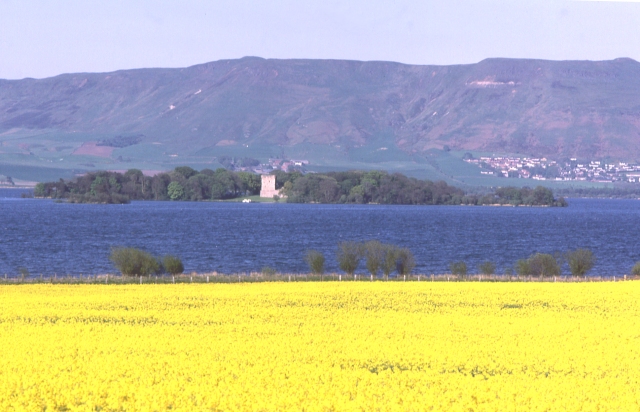
Looking across to Loch Leven Castle, with the Ochil Hills behind

... With regard to her flight, it is judged here, by those who know the site, and how strictly she was guarded, that her escape was most miraculous, most especially having been contrived by two lads, under ten years of age, who could not be presupposed to have the requisite judgment and secrecy. To the greater satisfaction with the result may be added, that the inmates of Lochleven Castle perceived the flight; but being shut up within it, and thus made prisoners, they had to take patience, and to witness the Queen’s escape, while they remained at the windows of the castle.

All having embarked, the Queen was conducted to Niddry, a place belonging to Lord Seton, and from thence to Hamilton, a castle of the Duke of Chatelherault , where his brother, the Archbishop of St Andrews, with other principal personages of those parts, acknowledged her as Queen.

... All Scotland is in motion, some declaring for the Queen, and some against her for the Earl of Murray.


And so the Marian Civil Wars officially began.
[Public domain images from Wikipedia.]

Monday, May 16, 2011

The best books and the best research tools - now from $10

If you are interested in the medieval or early modern past, the most important research tool for your research is now easier and cheaper than ever to access.

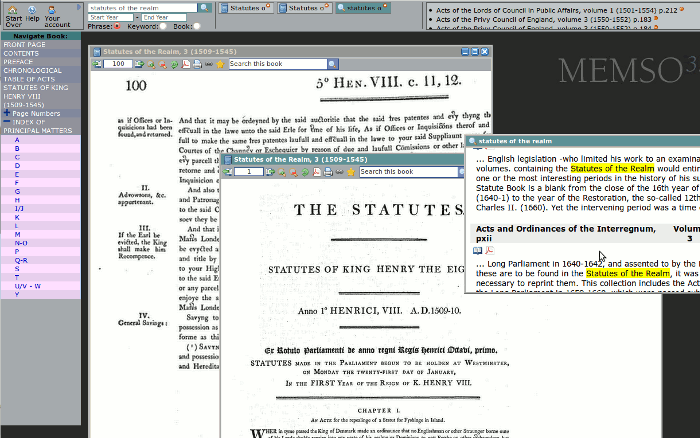
Working with multiple sources.
Not only are we currently providing personal access to Medieval and Early Modern Sources Online (MEMSO) at our cheapest rates during the Spring Sale, but you can now also access MEMSO for just $10, with unlimited searches, the ability to view and print the books contained in MEMSO, and the ability to download from our large collection of images from the British State Papers.


Why do I need access to MEMSO?


MEMSO contains a constantly growing collection of key sources for medieval and early modern history, specializing in the history of Britain and it relations with Europe, Colonial North America and Asia. MEMSO is also widely used across the humanities, and a key resource for English literature, religion and legal history.

But MEMSO is much than a simple collection of sources. MEMSO provides advanced tools to exploit the sources in ways impossible with the original books, or through any other web interface:-
      • Advanced, instantaneous full text searches of the entire resource, or just the sub-sets of sources you use.
      • Detailed bookmark navigation for each and every source in the database to find the material you need quickly - a unique and important difference between MEMSO and other online publications.
      • Consult multiple books and manuscripts, side by side. Researchers rarely have one book open at a time - you need to be able to open and compare many books at once. MEMSO implements an advanced desktop/window interface that lets you consult the sources in a way that dramatically increases the power and accessibility of this research tool.
      • Download full ebooks* and high definition scans of manuscripts to keep forever, print in full or use offline.
       It's not just the books - it's how you can use them.

      Designed by historians for historians, MEMSO is the unquestioned leader in providing, quality, accessible, historical sources, optimized for the way YOU work.


      TannerRitchie Publishing: The Trusted Source for Trusted Sources.


      Free trials for institutions also available: contact us for details.


      *Not included in $10 access period.

      The many different ways to use and view sources in MEMSO on display.

      Thursday, May 5, 2011

      SPRING SALE! Save on Short-Term Personal Access to MEMSO

      Screenshot of MEMSO in action

      Experience the power of MEMSO for yourself:

      • Our virtual desktop and windowing system lets you conduct multiple searches and work with as many books as you like simultaneously
      • Access our entire collection and keep ebooks permanently at the end of your access period.

      It’s not just about the books, but how you can use them.


      Buy access now!

      Access periodReg.% OffPriceEbooks to keep†
      1 day $45.00 10% $40.50 CAD 4 complete ebooks.
      3 days $90.00 10% $81.00 CAD 10 complete ebooks.
      1 week $135.00 15% $114.75 CAD 20 complete ebooks.
      30 days $225.00 15% $191.25 CAD 25 complete ebooks.
      90 days $360.00 20% $288.00 CAD 50 complete ebooks.
      †Ebooks to download and keep after the end of your access period.

      Thursday, March 24, 2011

      Fasti Ecclesiae Scoticanae published

      This week we have begun the process of republishing Hew Scott's monumental Fasti Ecclesiae Scoticanae, one of the most valuable reference works for historians of early modern and modern Scotland. Despite appearances, Fasti is not in Latin, and contains biographies of the Scottish presbyterian clergy between the Reformation in 1560 and 1900.

      "Your faithful &
      obedient servant, Hew Scott",
      editor of Fasti
      As always, TannerRitchie Publishing's editions don't just contain a simple digital scan of the work, but add a detailed navigation and search system that enormously increases the value of the works for researchers. Using the bookmarks, you can quickly get where you want in the books, which the full text search adds another dimension unavailable in the original volumes. Priced at $20, the volumes in Fasti are incredible value for valuable research tools.

      Meanwhile, as part of MEMSO, Fasti can be used side-by-side with the primary sources, or saved to your personal bookshelf for for frequent reference.

      Check out the first volumes of Fasti, available now, and keep on checking back as we complete the series in the weeks ahead.